



 Loading...
I saw a joke online earlier this week, and I need to share it with you: Who was the smartest person in the Bible? Abram, because he knew a Lot!
Well, as we heard in our first lesson, Abram, did know a person named Lot, his nephew, and together they followed the direction of God, and with Abram’s wife, Sarai, they moved from where they had built their life to the land of Canaan. This was a major change in their lives, especially because Abram was 75 years old. Even though they were aged, God made promises to Abram and Sarai, promises that seemed impossible for this childless couple. Yet as we will learn in the coming weeks, God’s promises to these people would come true, because they had deep faith and trust in their God.
Our reading from Romans could be considered a spoiler alert, since it reveals the promise God kept for Abram and Sarai. The promise of children and grandchildren. But more importantly, in today’s collection of readings, this letter from Paul tells the Romans about the possibilities that come with deep faith in God. Romans, remember, had overtaken Jerusalem, bringing their laws and soldiers to overtake the Israelites. They were sent to colonize and disrupt. It was their laws that made it legal to crucify Jesus.
And now, Paul is in Rome to teach and preach about the promises of God and the miracles of Jesus. And about how faith in God can lead to transformation.
Faith in God can lead to transformation. If we needed more proof than that of Abraham and Sarah becoming parents when they were old, we have, in our Gospel today, three stories of how faith in God and belief in Jesus transformed the lives of Matthew, of the family of Jarius, and of the unnamed, bleeding woman.
Normally, I would focus on the bleeding woman, 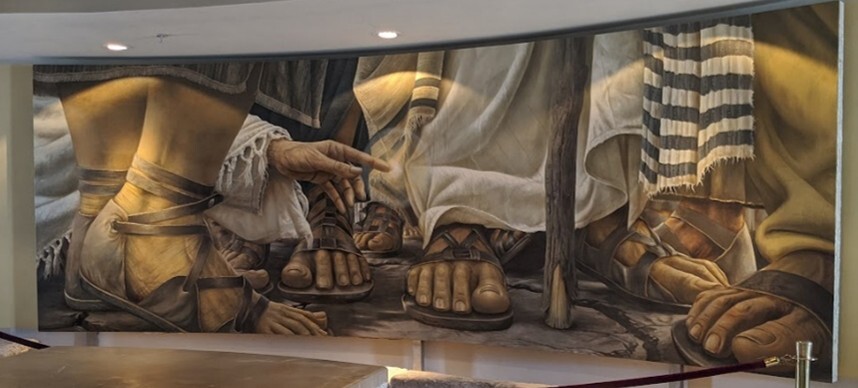 her willingness to drop to her knees, stretching as far as she can to touch the hem of Jesus’s garment. I would remind us of the risk she took to be in that crowd that day, a woman who, because of her continual 12-year hemorrhage is considered unclean and as a result would be separated from the community. She took a risk of faith, believing that simply touching that holy hem would be enough to provide her with relief. And it did.
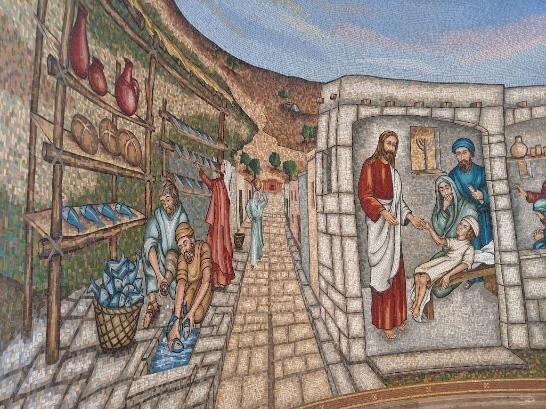
Or, I might focus on Jarius, a Pharisee, an important religious leader who, in his fear for his 12-year-old daughter’s life, took a risk of faith by going against other religious leaders, and asked Jesus for help to save his daughter. He trusted that even if others were skeptical of Jesus, he would do anything to help his beloved daughter. And she recovered.
These stories of risky faith, trusting in the healing powers of a man who challenged so much of what devoted Jews believed, are testaments to the transformative power of God. These people were willing to risk their current circumstances to express their faith in God. They were desperate because they knew there was nothing more that they could do. They needed to have faith to know that God would help, that their needs would be met.
That is a touchpoint when we think about faith. For some people, it takes getting to a breaking point, as this bleeding woman and synagogue leader reached, to know “where our limits are and know that we have to look outside of ourselves to the God who is greater. We live,” according to Chelsea Harmon, “by faith in Christ’s strength, not by our own strength.” [1]
And these are great examples of what having faith in Christ’s strength and not our own, looks like.
This year, I’d like to talk a bit about Matthew. He gets so little attention in this passage, but when we focus on the larger impact of his story, when we consider the political and social climate of that time, the story of Matthew becoming the last disciple called by Jesus is extremely important.
Matthew, whose name in Hebrew means “gift of God,” was a tax collector by trade. Not that he chose this line of work. You see, at this time, Rome had colonized the territory and terrorized the people living there. The political leaders from Rome were brutal. They would force Jewish men to do jobs that would pit them against their neighbors, friends, and family. Matthew just happened to be one of those Jewish men forced into this situation.
It was a horrible assignment, requiring him to make his community pay taxes to their enemy, the conquerors, the colonizers, the Roman Empire. He would be resented, hated, and likely, shunned from communal activities. He might not have been considered “ritually unclean” like the bleeding woman or the dead girl, but he certainly touched a lot of currency that might have been tainted in some way. He was probably ridiculed, and called a traitor by his people, even though he had been forced into this job.
And then, Jesus finds Matthew, telling him to get up from his tax booth and follow him. He is set free from the Roman Empire, relieved of the burden of and hopefully forgiven for harming his friends and neighbors.[2]
Yet, forgiveness takes time, and Jesus has just introduced someone onto his team who, even if they understood Matthew had no choice in the matter, he had created hardship for the Jews. And it might have been hard for Matthew to feel comfortable in this new group.
Jesus was good at that. He tended to invite some of the most questionable people into his circle, possibly stirring up emotions within the community. Doubt. Suspicion. Maybe even disrespect or fear because this man was thrust upon them without their input. Could they learn to trust someone who had been imbedded with the Romans? Would what he did for work make him less of a Jew? Would his faith in God have been challenged to a point of no return?
There are two things about the calling of Matthew that make the answers to these questions easy. First, Jesus saw something in him that made him invite Matthew to come with him. Second, Matthew did not hesitate to get up from his table and leave it all behind him.
Jesus chose him. All of who he was. He knew that the work Matthew was doing could not define what was in his heart. He knew that he needed Matthew to be a part of the story. Jesus knew that his invitation to Matthew was just one more way to help people know that God’s love is for everyone.
Matthew did not hesitate. His faith made him follow Jesus, leaving what he knew was suffocating him, to start a new life where he could learn that even he, a tax collector, was a beloved child of God.
That’s the point of all these stories of faith. Abraham, Lot, Sarah, Paul, Jarius and his family, the bleeding woman, and Matthew each had had enough of what they were enduring to recognize that they could not fix or change their circumstances without God’s help. Whether we consider each of these scenarios as desperation or not, each of these people took a risk of faith, trusting that by giving to God what they could no longer hold alone, they would change their lives and be transformed by God’s grace.
Each one of these people got up from what they once were to follow God, to follow Jesus. And through the act of getting up, taking a risk of faith, they were transformed.
I love what Matthew Myer-Bolton wrote about getting up and following God, about the radical welcome that comes from knowing Jesus. He wrote:
“… no-one is disqualified from becoming part of the movement — and indeed … Jesus is most interested in people who need help, just as a physician is most interested in people who are sick. … Jesus is a healer: he comes not to reward or congratulate those who are already well, but rather to help us become well in the first place. …” He goes on…
“Healing comes in many different forms, physical, emotional, social, and otherwise, and we can trust that our most daring, faithful efforts will be met with God’s merciful healing touch, regardless of the form that healing takes in any given case. [3]
God, Jesus, and the Holy Spirit call us to get up and follow, not because we have our lives “together,” or we are healthy in mind, body, or soul, or we know and understand the mystery of faith, or that we fit a certain mold. No.
We are invited to get up and follow because no matter our circumstances, our history, our mistakes or our successes, we are worthy.
We can be like Abram, who got up and relocated his family to start over someplace new, even in old age.
We can be like Paul, whose whole life turned upside down when he got up after being blinded by the light of Jesus, to become one the most well-known letter writers of all time.
We can be like Jarius, who got up from his seat as a Pharisee to beg Jesus for help.
We can be like the woman, reaching out in her distress, and who got up, healed and whole.
Each one of these people took a risk of faith, got up, asked for what they needed, and were met by a loving, life-giving God.
And so can we.
Amen.
[1] https://cepreaching.org/commentary/2026-06-01/matthew-99-1318-26/
[2] https://provokingthegospel.wordpress.com/2026/06/03/a-provocation-second-sunday-after-pentecost-proper-510-matthew-99-13-18-26-june-7-2026/
[3] https://www.saltproject.org/progressive-christian-blog/2023/6/3/go-salts-commentary-on-second-sunday-after-pentecost
Photos by Very Rev. Debbie Dehler in Magdala, Israel, February 2020.