




 Loading...
I’d like to tell you about the picture I inserted into today’s leaflet. It’s a small portion of a large mural found in the lower level of the church at Magdala, in Israel.
This was just one of the stops we made as we traveled near the Sea of Galilee, when I was in Israel in February of 2020.
The church was recently built at the edge of the Sea of Galilee. I say “recently,” because the ruins of the synagogue and fish processing system were found when a developer who wanted to build a hotel, put a shovel in the earth and uncovered this place where it is believed Mary Magdalene grew up.
To mark this spot, to offer the opportunity to study both the synagogue ruins and the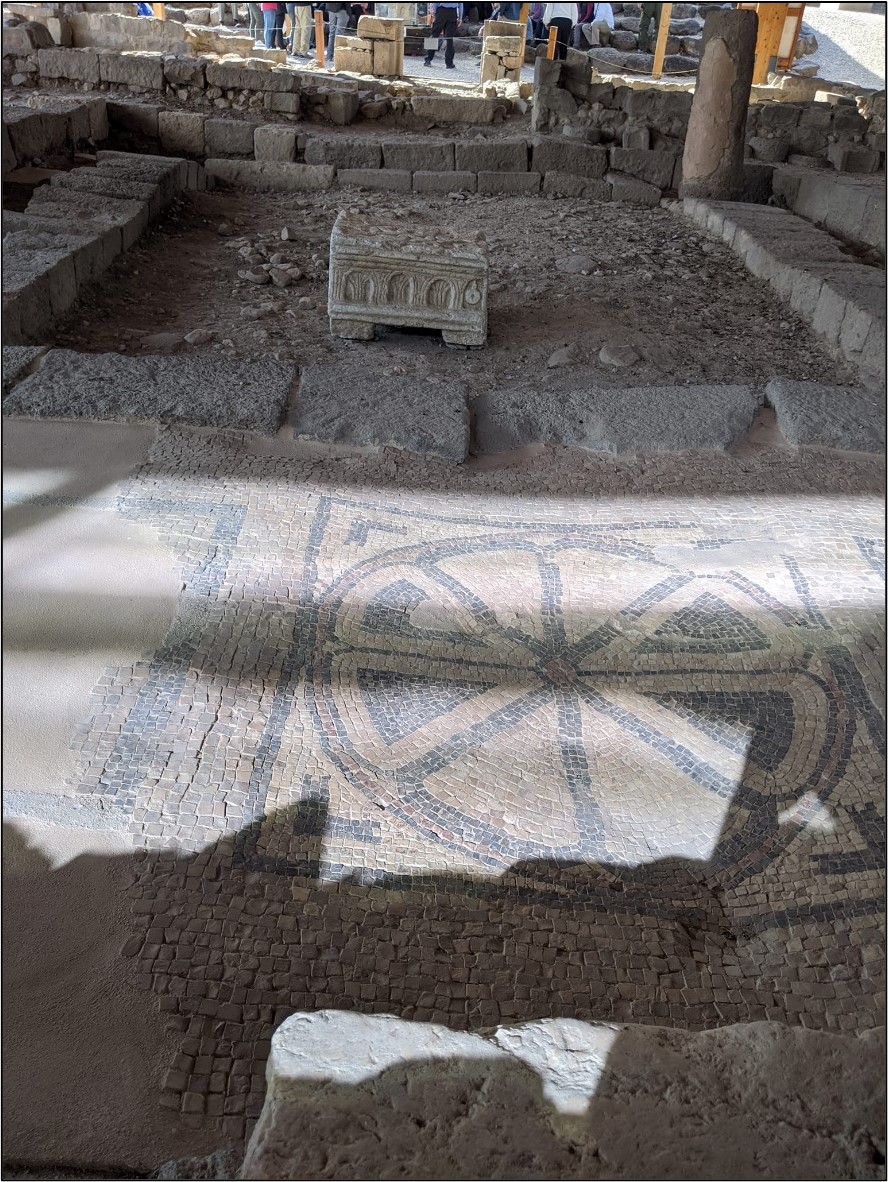 remains of the fish processing system, and to preserve the mosaic floors, the acres of land became preserved for pilgrims and historians, seeking to walk where Jesus walked, or to find solace in the place of worship found here.
The church itself is modern. The altar looks like an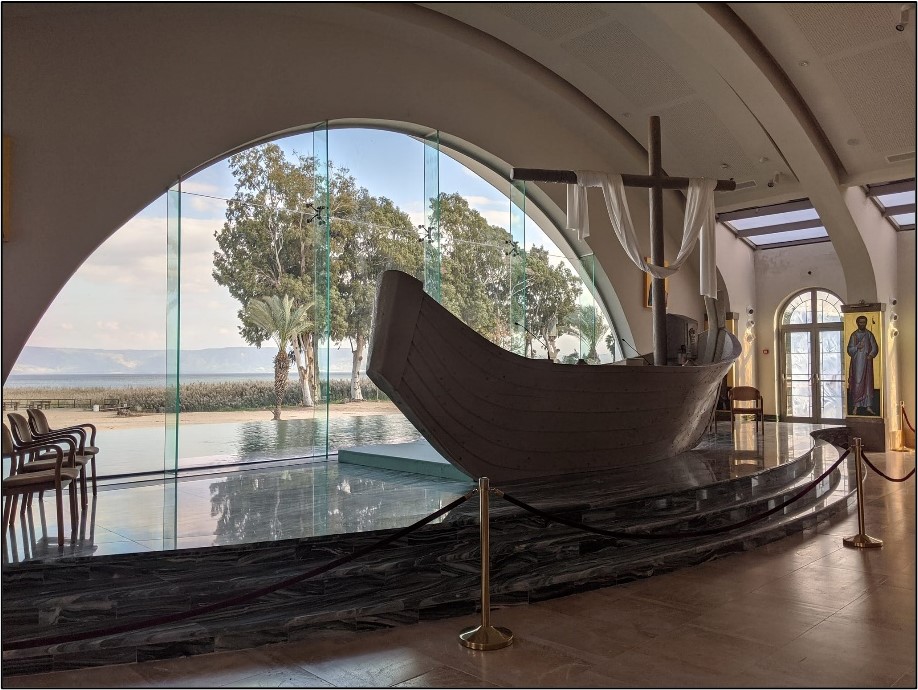 ancient fishing boat upon blue marble that looks like the waves of the sea. Behind the altar is a wall of glass overlooking the Sea of Galilee. Palm trees stand tall and wave in the wind in between. Sand and scrub brush reach from the building to the water.
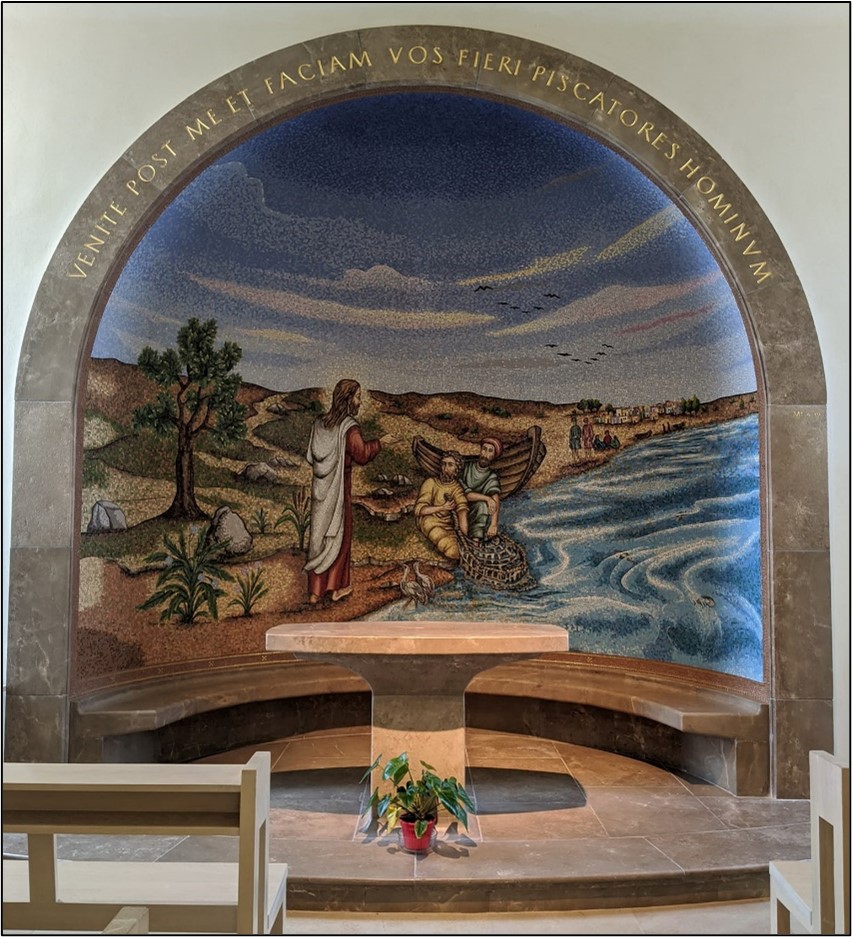
This church at Magdala is filled with holy art. The major medium is mosaic tile. Around the sanctuary are small chapels with arched alcoves filled with tiles designed to tell stories of Jesus and his ministry around this area.
Jesus meeting our namesake, James and his brother John at the shore, mending their nets:
Jesus meeting the woman at the well. 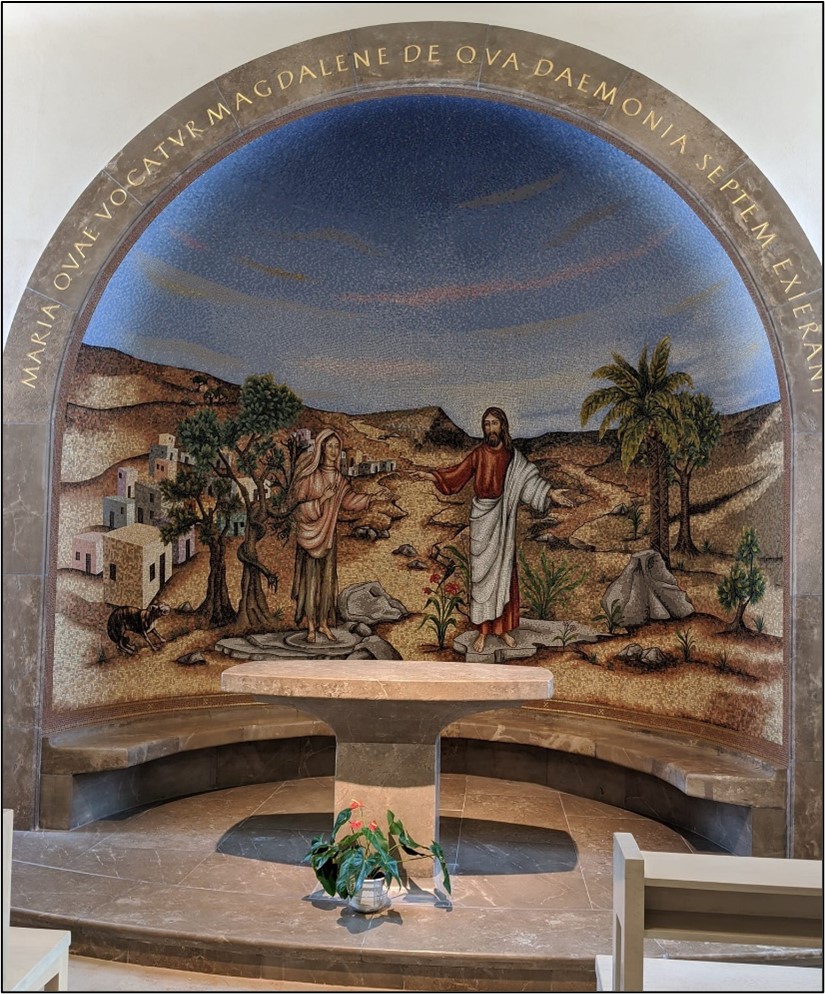
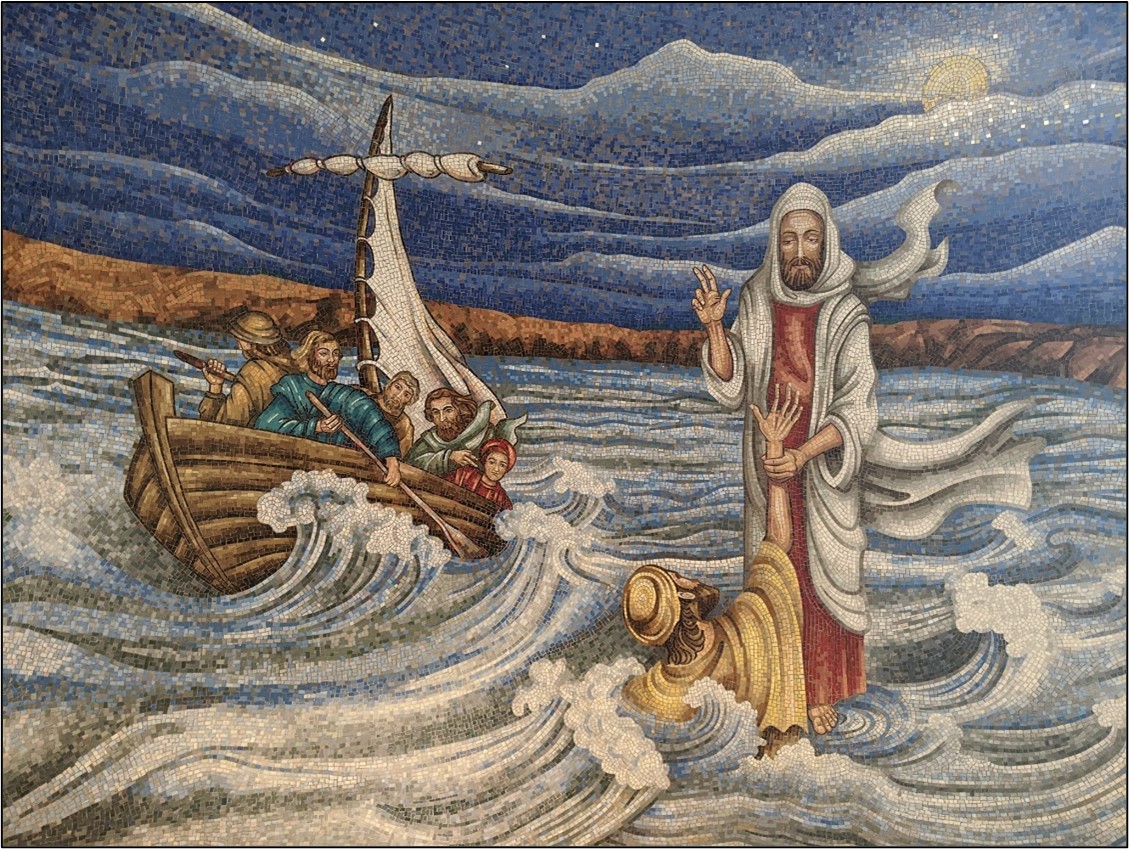
Jesus walking on water and saving Peter from sinking:
And finally, from today’s Gospel, the moment Jesus heals Jarius’ 12-year-old daughter:
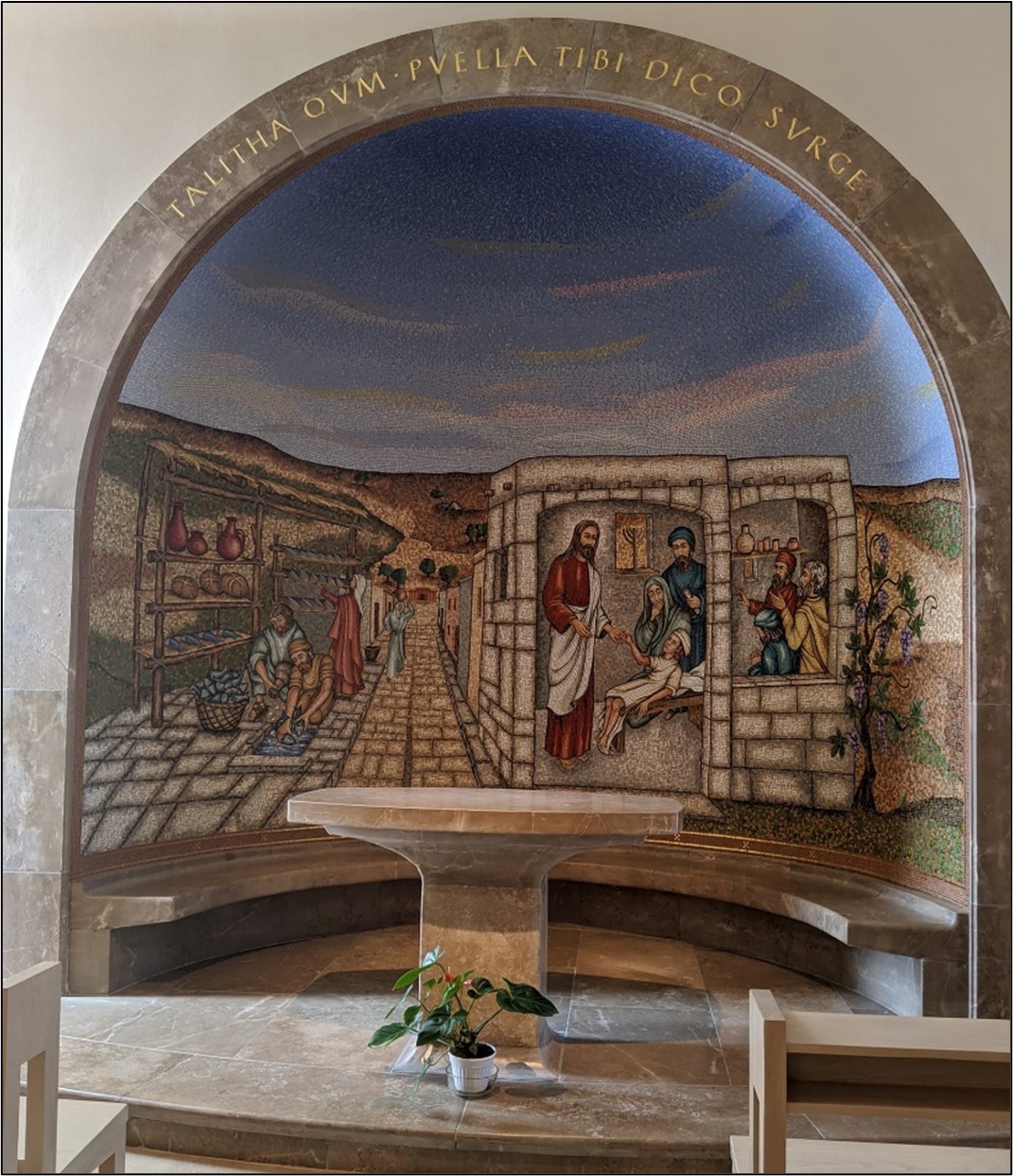
The Gospel story is like a sandwich. It begins with the request from Jarius to come quickly to heal his sick daughter, then is stuffed with the story of the woman who has hemorrhaged for 12 years, and then ends with Jesus healing the girl.
While I placed a photo from the middle of the sandwich in our leaflet today, these few minutes, or maybe hours of Jesus’ life must include the story of the girl.
Because the power of God is manifested in the lives of these two female characters.
Two female characters—neither of any real importance. One, perhaps a pre-pubescent girl, nearing the age to be betrothed. She was the daughter of a Jewish leader, but still, only a girl. The other, a woman, either shunned by her community, or self-isolated due to whatever was making her bleed. Poor, now, after spending her resources on physicians who could not help her. Still, only a woman.
If either were to die, in the grand scheme of things, it would not have mattered. Their families may grieve, but they were only females, and in the eyes of many, of no real worth. Marginalized. Shunned. Easily forgotten.
But Jarius came to Jesus with hope, begging Jesus for help to heal his daughter because he knew she was near death, and Jesus agreed to go with him.
Jostled as the crowd grew around them, Jarius led Jesus toward his home. People bumped into them, as any crowd would do. And in this crowd was a woman, unclean, who elbowed her way into the mass of humans, drawing nearer and nearer to Jesus, with hope that this man she had heard of just might be able to cure her. She said to herself, “If only I could touch even the hem of his garment, I will be rescued…”[1]
Think about what that might look like. Where would she need to be to touch the hem of his clothing? Could it be possible she was stumbling through the crowd on her hands and knees, crawling, being stepped on, to simply touch his hem?
Look at the photo for a moment. Can you see the light at the end of her fingertip? The light of Christ bonding with her, healing her, returning her to wholeness?
Now imagine this whole piece of art. It is a mural that must be almost 20 feet long and 8 to10 feet tall. And it is almost entirely a mural of feet up to the mid-shin.
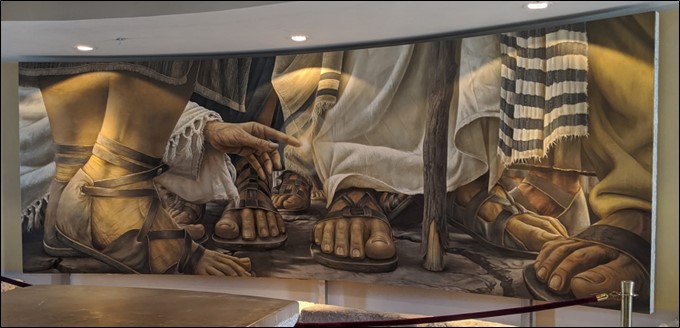
On the left, imagine the sandaled feet of a man, turned toward the right foot of Jesus. It seems the men have stopped to talk, because to the right there is another foot, blocking Jesus’ path. It seems it is Jesus who is wearing a white robe and a striped prayer shawl, and he is leaning on his staff, his walking stick. There are other feet behind Jesus, all wearing sandals. But behind those first feet I mentioned, the feet on the left, a woman’s arm is reaching, stretching as far as it can to touch the hem of that white robe.
She is at ground level, and inconspicuously reaches as far as she can … and makes contact with the hem of his garment!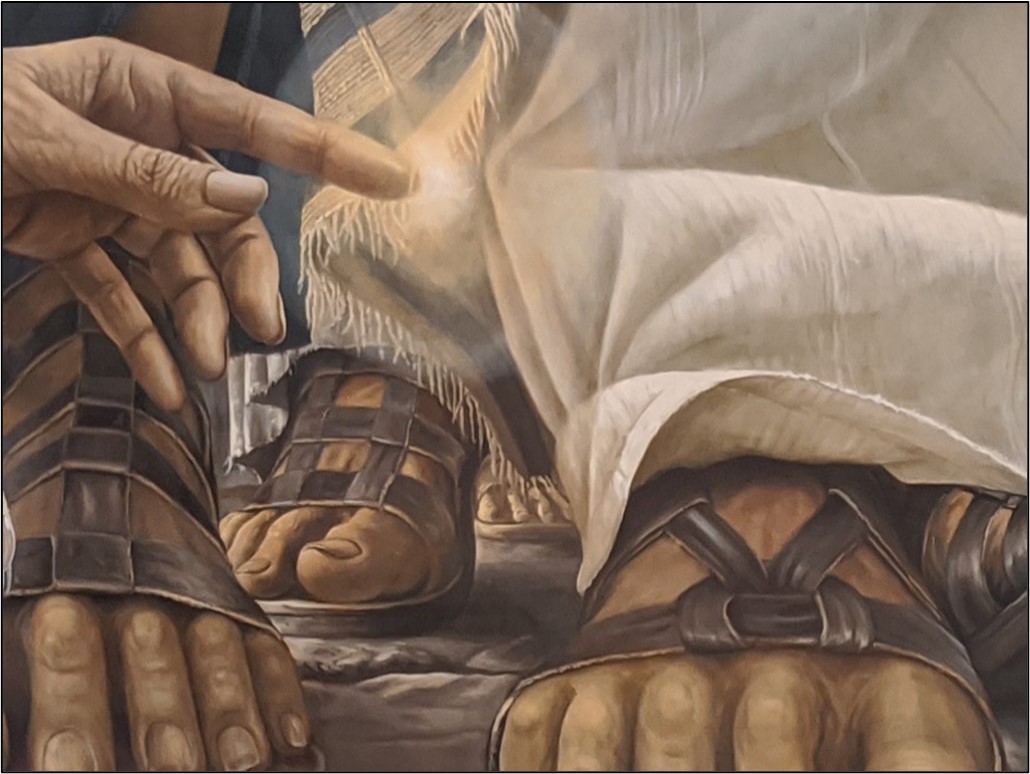
A spark.
An immediate stop to the flow of blood.
A sense that some power has left him.
A seemingly impossible question to answer:
[angrily] “Who has touched my clothes?” or was it
[inquisitively] “Who has touched my clothes?” or could it have been
[gently, like a whisper] “Who has touched my clothes?”
The disciples must think he is crazy to expect anyone can answer this question. And yet, Jesus knew that the touch from this mysterious individual was a touch of need, of desire, of hope, that God could help them with whatever it was they needed.
The woman could have slithered off or simply stayed crouched in the crowd, but she, though terrified, boldly, or maybe even meekly, said, “It was me,” and explained why she did what she did.
Jesus listened to her. He did not rebuke her or punish her. He listened to what she had gone through for the past 12 years, and he sympathized with her. He reassured her that when she touched his garment she was truly healed because she had faith that Jesus could help her.
This exchange may not have lasted very long, but it was too long for Jarius’ daughter. While Jesus looked upon this woman with compassion and provided her grace, someone came to find Jarius to tell him it was too late, to stop bothering the teacher. His daughter was dead.
But Jesus has power that surpasses all our understanding, and he was able to go into this house of mourning and wailing and keening and take the 12-year-old girl’s hands in his and tell her to get up, and she does.
Both females were unclean in the eyes of the community. Blood. Death. Only their closest family could touch them. Others would fear contamination that would make them unable to participate in daily communal life and worship. A woman and a girl. One who is probably close to menopause and the other who is close to womanhood. Their lives entwined simply by 12 years and a visit from Jesus, the healer and savior, bringing the power of God to the world.
He could have left them in their circumstances, like so many others would have, but through this and so many other stories, Jesus shows us what the dignity of every human being looks like. He teaches us what it means to respect and love every person created by God. He provokes us to get to know the stories behind the faces—to build relationships, especially with people who might have a different culture, religion, viewpoint, education, or life experience from our own.
I had a lot of memory on my phone to bring back around 1200 photos of the places I visited in Israel in 2020. I value these photos because they remind me of the moments and experiences from this educational pilgrimage. But there are some that stand out, like the one I have shared with you today.
Looking back on our time in Magdala I’m reminded especially of the ways Jesus ensured that women in his time knew of their belovedness. We can choose to read scripture in ways that make it sound like he dismisses the women, or we can choose to read it as if he admires and lifts women to a place of honor. I prefer the latter!
Today, we are going to welcome two twin girls into the household of faith when we baptize them in just a few minutes. And while I know they are too young today to know the importance of this day in their lives, we know. And as we move forward in this service of baptism, we, too, are invited to renew our baptismal covenant and to be reminded that when we promise to follow in the footsteps of Jesus, we are promising to love, to respect, to strive for justice, and to seek peace.
In today’s Gospel we hear Jesus as he expresses respect by listening to both Jarius and the woman—to hear their stories and get to know them more deeply. He offers justice to women by healing them. He shows those around him what it means to speak in ways that seek a peaceful resolution. And above all else, Jesus exemplifies what it means to love one another by lifting up the lowly and raising them to a new life in Him. Amen.
[1] Swanson, Richard, Provoking the Gospel of Mark, The Pilgrim Press, Cleveland, Ohio, 2005, pp. 274-276.