



 Loading...
Let the God of hope fill us with all joy and peace in believing through the power of the Holy Spirit. Romans 15:13
Beloved, welcome to the 199th Convention of the Diocese of Kentucky!
This annual gathering is always a joy, and we are so grateful to the people of Grace Church [in Hopkinsville] for their warm and generous hospitality!
I have chosen an unofficial theme of our time to be Hope.
Depending upon the translation, the word “hope” appears in Holy Scripture as many 365 times.
In the New Revision Standard Version which I most often use, it is found 202 times according to the non-generative artificial intelligence source I used. Our English word hope has at least 8 root words in Hebrew. (You are welcome to look them up!)
This morning I am going with the definition set forth by The Rev’d Jon Swales MBE—a Church of England priest, theologian, poet, and lover of souls, in his poem "Hope Leans Forward," he describes hope as having a "holy audacity" and a "quiet trust and boldness" that moves directly toward pain rather than retreating from it.
I could read his work to you, but it is better to hear it from the author, as he is driving his automobile no less! Here is [that poem], Hope Leans Forward, by the Rev’d Jon Swales:
Hope leans forward, tender,
listening to the whispers of creation groaning for renewal.
It does not turn its face from shadows
but gazes through them, finding in the darkness
the first faint glimmer of dawn.
There is a holy audacity in hope—a quiet trust and boldness,
knowing the story is held in hands not our own,
nail scarred hands that invite us to weave and work with them
a future of beauty and grace.
Hope speaks where fear falters, narrating a kingdom,
telling a story where the scattered are gathered,
where the weary find rest & the exile a home.
It does not retreat, nor stumble
beneath the solemn, world-weary weight.
It moves with sacred purpose,
a searching grace, a steady faith.
Hope is a spring, a foretaste, an existential refreshing
a momentary liberation that lifts us from despair.
Hope knows the wounds of this world,
but counters fear with holy persistence, & holy resistance,
declaring that there is not a hurt he will not heal.
Hope, a gift, a call to action,
a quiet confidence that moves towards
the pain—not alone,
but with hands outstretched,
pulling the darkness of this world
towards the light of Christ.
Hope leans forward, Tender,
‘Be ready, Greet it with a kiss.’
"Holy audacity", "quiet trust and boldness", moving directly toward pain rather than retreating from it or masking it in platitudes.
The Greek New Testament uses the word elpis to denote a confident expectation, assurance, and anticipation grounded in the character and promises of God, which is markedly different from modern English usage implying a wishful or uncertain "I hope so".
The Greek affirms that hope is grounded in God alone, as in the proclamation at the grave: In sure and certain hope of the resurrection as mortal remains are laid to rest.
This hope is the certainty upon which we base our mission and ministry in our diocese. Hope in God fills each of us, is fed by and manifested in the life of each congregation. Knit together in one communion and diocese through baptism, we reflect and share the hope of the world, Jesus Christ our Lord.
In this context of hope, I commend to you the advance reports that provide a narrative of hope being shared by you, and to be shared in the coming year of grace.
A budget is often called a mission statement, setting out priorities, testifying to the hope we share.
Jon Swales defines hope not as a cheap, romanticized abstraction or blind optimism (which he calls "hope-ium"), but as a fiesty, dirt-under-the-fingernails reality that unflinchingly faces the pain and brokenness of the world and runs toward it.
Hope is not a naive or passive feeling, but as something tender yet resilient that listens to the "whispers of creation groaning for renewal". Renewal often emerges from giving thanks and letting go.
This year two of our congregations celebrated Holy Closure: Messiah-Trinity, a joint ELCA-Episcopal church, and St. Thomas’ in Louisville.
The respective decisions for closure were reached after prayerful discernment and evaluation. Each Liturgy of Holy Closure included giving thanks for the legacy of faithful worship, ministry, and mission. In the services were tears as well as smiles and laughter. Following the reception of Holy Communion, thanks was given to Almighty God, deep and abiding trust in God was expressed, and confidence in God’s next chapter to be written. The Holy Spirit was at work.
Renewal emerging from the Messiah-Trinity legacy of faith is a new congregation in formation. Trinity South Sudanese Episcopal Church is led by their priest the Rev. Daniel Kuol.
This community meets for worship Sunday afternoon. They have been able to meet in the building formerly owned by the ELCA congregation at Messiah-Trinity. I anticipate that in the new year they will need to find a new home. They are hopeful, and I am hopeful, that a Louisville congregation will be willing to engage in conversations with my office, Father Daniel, and Trinity’s lay leadership about a new home.
The Executive Council of the Episcopal Church has recommended this congregation for funds from the Next Faithful Steps program, focusing on multicultural and inclusive communities. The application was coordinated by Canon Jason Lewis. Eighty-five communities applied for the grants; Trinity South Sudanese Episcopal Church was one of twenty-nine recommended.
Trinity South Sudanese Episcopal Church has a great legacy of its own, a tangible expression of dirt-under-the-fingernails, always trusting in God’s sure and certain hope.
This is a tremendous affirmation by the wider Church, and we celebrate with the people of Trinity South Sudanese Church! Can I get an Amen?!
As the people of St. Thomas held their final celebrations of the Eucharist in April, God was praised for 117 years of ministry. Neighbor’s needs were met, immigrants and refugees were sponsored and supported, the hungry were fed, and the parish welcomed all.
The people of St. Thomas were lovingly supported by the people of St. Paul’s Church in Louisville and the pastoral support of St. Paul’s rector, The Rev. Andrew Shirota.
Working with the lay leadership at St. Thomas and priest-in-charge, the Rev. Rick Kautz, a significant focus of Holy Closure was the translation of the St. Thomas Memorial Garden to the St. Paul’s Memorial Garden.
Symbolic containers of earth from St. Thomas were buried at St. Paul’s at the conclusion of the Sunday Eucharist on April 19, with the names of those previously buried at St. Thomas being honored. It was an intentional, pastoral process in the Easter Season, an integral part of Holy Closure, a manifestation of hope and renewal.
The 7 acres campus that was home to St. Thomas is now for sale, and interest has been shown by several parties. The Standing Committee will oversee the final disposition of the property. We are at the appraisal stage. As always, I am being so ably advised by our chancellor Hamp Moore and supported by Treasurer Charlie Hawkins.
Hope is best nurtured in community. Where two or three are gathered, God’s hope is found. For some time now, throughout our diocese, community is being strengthened.
Reckoning with racism, seeking racial healing, and engaging in the hard work of discerning what justice and equality should look like today and in the future through the Racial Healing Commission and Racial Economic Disparities Task Force has richly blessed us. We have come to know each other in demonstrably fruitful ways.
You will be asked to approve a resolution merging those two bodies into Building Beloved Community Together which will be the primary working group to support us in moving ever closer to repairing the breaches that the legacy of racism has left in our congregations and communities. [We did approve this.]
Likewise, the Diocesan Task Force on Structure and Relationship has opened new avenues of mutuality between congregations.
The four priorities set forth in the Task Force report have all produced fruit:
1. Diocesan Video Sermon Program
2. Relationship Between Congregations with Clergy and Those Without [clergy]
3. Lay Worship Leader Training
4. Communion from Reserved Sacrament
There are moving testimonials that emerged from these relationships, blessings not anticipated as we embarked on this discernment. A component of the Task Force’s work asks congregations to share their priest at least once a year with a congregation without a priest-in-charge, to preside at a Eucharist and preach, which can lead to additional connections.
I am thrilled to announce that, based on one parish’s experience of sharing their priest, a Clergy Supply fund based upon the task force’s guidelines, has been established to cover expenses for sharing clergy with a congregation that relies on supply.
Covered expenses include mileage, overnight accommodations and meals if needed, and the supply fee for the priest to preach and celebrate the Eucharist. This fund will run from the beginning of Advent in a few weeks through the Feast of Christ the King in 2027. Contact the Rev. Benjamin Hart, rector of St. Luke’s Church, Anchorage, for the clergy supply fund.
Embedded in Father Swales’ writings is the bold assertion that Hope is not passive; it is a "gift, a call to action" that works alongside nail-scarred hands to weave together a future of beauty, grace, and renewal—even in the face of ecological crises, injustice, and human suffering. This is Cruciform Justice.
In baptism, we are signed with the cross, our lives marked and shaped by the cross, continually nurtured in formation.
In 2027 we will launch a Pilot Formation program, supported by the Rev. Canon Brian Ponder. This Pilot program will explore opportunities for a cluster of 2-3 churches to partner together for ongoing adult Christian education and formation. This in turn will serve as a model for future cluster opportunities based on best practices.
The effort will explore:
- opportunities to deepen our faith and spiritual lives
- ways to live out our Episcopal identity
- ways to be formed for service in the wider world
- Online Youth Confirmation Class for churches currently without clergy leadership, initially led by members of the diocesan staff and others
- Monthly Online Book Study that will bring the diocese together informally for conversation and fellowship [and finally, a]
- Diocesan Gathering at All Saints Camp and Conference Center, for a day-long informal gathering of food, fellowship, fun, music and community building.
More info on the pilot program, including a better name, coming early next year.
We are gathered here in Hopkinsville where blessed Alexander Hamilton McNeil, aka Aaron McNeil, labored in hope to produce hope. The October commemoration of the Rev. A. H. McNeil was transferred to today.
Thanks to Amy Spicer and helpers who researched A. H. McNeil, we have a hagiography, a holy biography of one who worked tirelessly towards the cause of improving the circumstances of blacks in the communities in which he lived and worked.
He knew that education was the gateway to equality for all of God’s children. McNeil, the first ordained black man to serve in our diocese, also worked to bridge the man-made divide between the races following the Civil War, in a community 11 miles from Jefferson Davis’ birthplace. Deacon McNeil ran towards pain, fear, and inequality, finding in darkness the first faint glimmer of dawn to build a beloved community.
The people of Grace Church, and all of us in this diocese, strive to honor the achievements he made and to live into this holy legacy. (a moment of silence)
I wish to give thanks for my staff colleagues in the bishop’s office. For Brian Thomas in his fine work with all things financial assisted by Kate Jordan.
For the Rev’ d Larry Minter, Chaplain to the retired clergy and spouses for his faithful care.
I have already mentioned Canon for Congregational Vitality Jason Lewis and Canon for Formation Brian Ponder with examples of their faithful work, which brings me to Canon to the Ordinary Amy Real Coultas, who has a never-ending job description. There is no area of diocesan life and thus life in each of our congregations that she does not touch, support, and make better. I am so grateful for her gifts, and for the support of those canons.
Beloved, Hope leans forward, Tender, ‘Be ready, Greet it with a kiss.’
True hope is grounded in faith expressed in "nail scarred hands", and compels us to move toward pain, walk alongside the marginalized, and actively work for justice and healing where God has placed us. This hope pulls darkness towards the light, sharing mercy and grace for all.
Hope speaks where fear falters, narrating a kingdom, telling a story where the scattered are gathered, where the weary find rest, and the exile a home.
May God bless us with passion for such Hope. May blessed AH McNeil inspire us and pray for us.
Hope Leans Forward. And so does the Diocese of Kentucky.
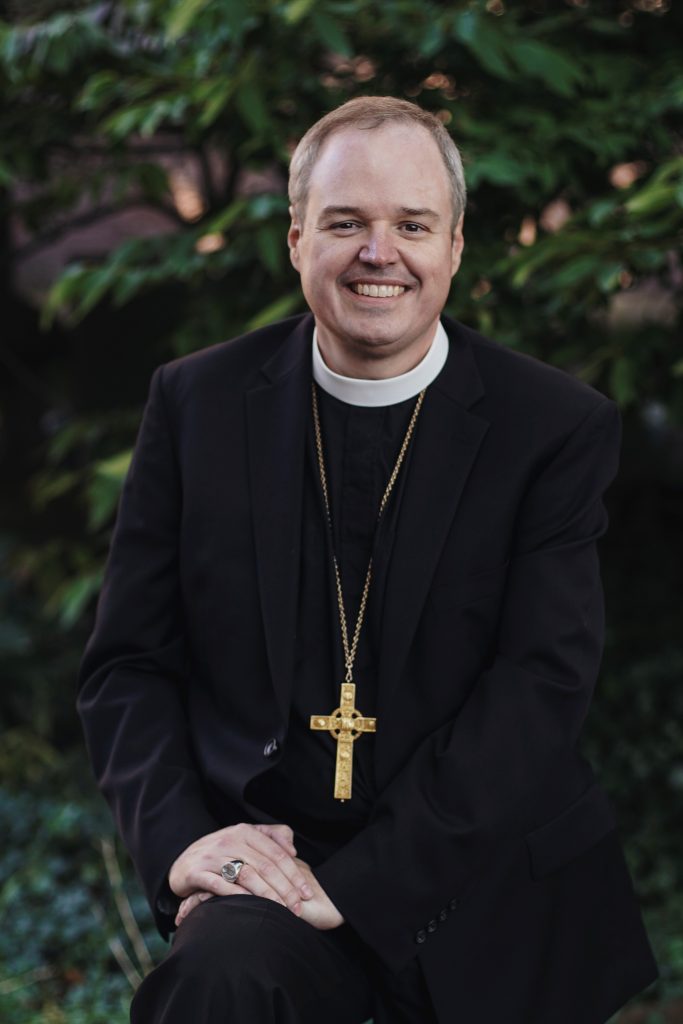
[Again, these have been the words from our Bishop, Terry White, shared yesterday at our diocesan convention. I share them so you can hear some of the news of the diocese and listen to the hope for the future. The work of convention was fruitful. Many of the initiatives begun in the past few years are becoming realities. Both Deacon Mary and I were elected to new roles to support the work of the diocese. There is much to look forward to, and I pray we do it with hope. Amen.]

Leave a Comment